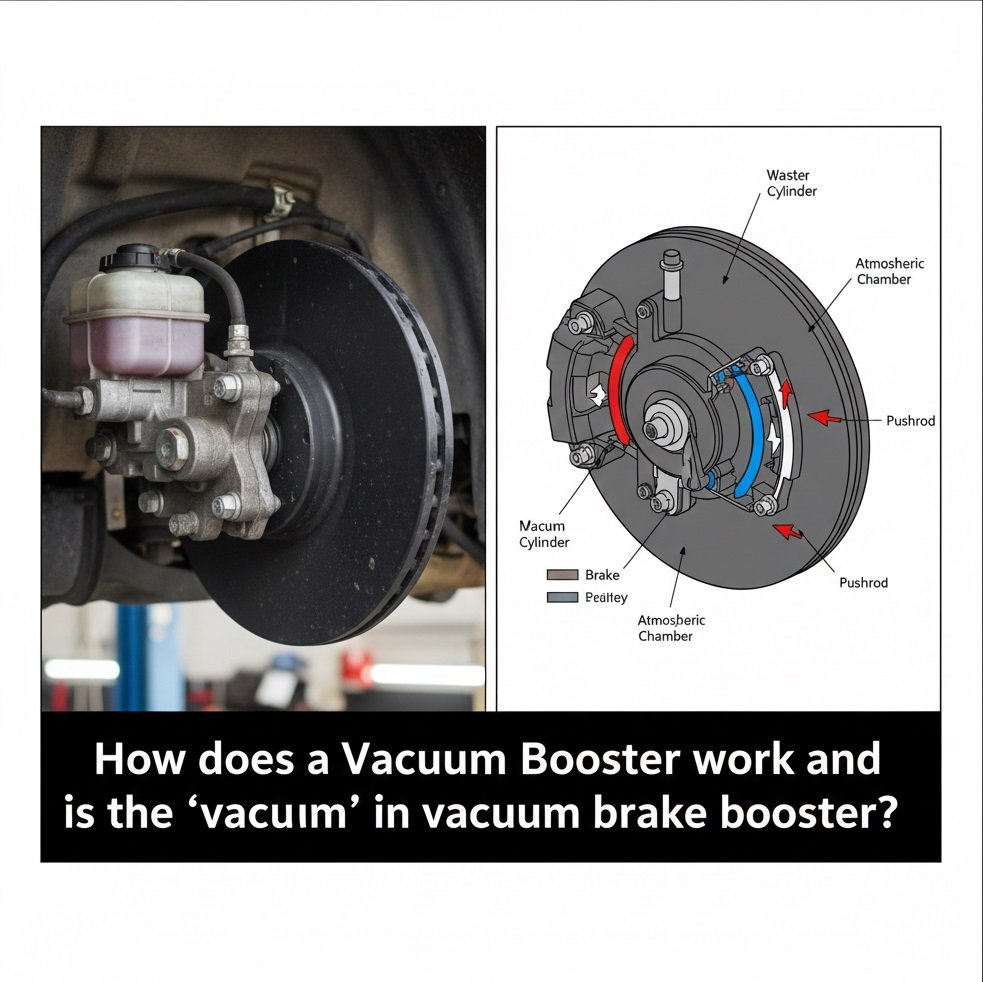
How does a Vacuum Booster work and what is the ‘vacuum’ in vacuum brake booster?
With exertion you can smoothly and steadily halt your two-ton automobile by merely pressing the brake pedal. Have you ever considered how that slight pressure, from your foot is increased to a force enough to stop a vehicle in motion? The vacuum brake booster is an overlooked champion that enables this feat. It is a part that enhances your braking strength making driving safer and more convenient.
Starting around 2025-2026 as hybrid and electric vehicles become more common the technology used in brake boosters is evolving. This article will cover the vacuum brake booster: its principles, its power source and its role in the future landscape of automotive safety, in 2026. Whether you’re a car enthusiast or just a curious driver this book offers a technical, but accessible explanation of this critical element of the 2025 braking system technology.
What is a Vacuum Brake Booster?
A vacuum brake booster, also known as a brake booster is an electrical apparatus that utilizes a vacuum to amplify the force applied by your foot on the brake pedal. Its purpose is to lessen the strain during braking and it is positioned in the engine bay, between the pedal and the master cylinder.
This implies that at velocities significant force, on the pedal—practically pressing down hard—is necessary to generate the hydraulic pressure needed to halt the vehicle without a booster. A crucial element of vehicle safety and driver ease is that the booster facilitates effortless and sensitive braking.
What does “vacuum” refer to in the context of a vacuum brake booster?
The term vacuum is essential in describing the function of this part. Simply put a vacuum is an area devoid of matter. Nevertheless in engineering practice a vacuum is regarded as a condition where the pressure’s significantly, below that of the ambient atmospheric pressure.
This difference, in pressure provides the vacuum brake booster with its force. The interior of the booster chamber is consistently maintained at a vacuum or reduced pressure. When the pedal is pressed a valve opens to allow pressure (higher pressure) into the chamber. Air naturally flows from regions of pressure to areas of lower pressure. This atmospheric pressure and air flow create a force that pushes a piston and diaphragm which then help your foot in activating the brakesTherefore, vacuum does not absorb; rather, it creates a situation where atmospheric pressure can push and help.
How a Vacuum Booster Works: A Step-by-Step Guide
The functioning principle of the brake booster is elegantly straightforward depending on the struggle, between atmospheric pressure and vacuum. The operation proceeds as described:
Resting (Brake Pedal Released): When the brake pedal is released the booster remains balanced. An atmospheric valve remains shut while a vacuum valve stays open. The vacuum pump or engine continuously removes air from both sides of the boosters diaphragm creating a vacuum on each side. Because the pressure is identical, on both sides no net force is generated.
When the brake pedal is pressed (engaging the brakes):
Initial Stroke: When the brake pedal is pressed for the time a push rod advances, which initially seals the chamber from the vacuum supply by triggering the vacuum valve.
Presenting Atmosphere: The relentless advance of the pushrod activates the valve. This permits air at standard atmospheric pressure to flow into the compartment, on the driver’s side of the diaphragm.
The Difference, in Pressure Generates Force: A significant pressure disparity exists. One side of the diaphragm experiences pressure while the opposite side is subjected to a vacuum. The higher atmospheric pressure pushes the diaphragm and its connected piston toward the side with pressure.
Force Enhancement: In this method the pressure, from your foot combines with the thrust of the diaphragm. Together they exert force on the master cylinders piston, generating hydraulic pressure to activate the brakes on all four wheels.
Operating the Brake-Pedal Set: The valves keep a pressure differential and consequently a consistent amount of support, without rising or falling when you keep the pedal in a fixed position.
Brake Release (Pedal Released): Upon releasing the pedal the foot is taken off. The return spring forces the diaphragm to move back. This action closes the valve once more and opens the vacuum valve again. The booster swiftly removes the air that entered and reestablishes vacuum on both sides of the diaphragm resetting the system to its resting state, for the brake application.
The entire vacuum-assisted braking operation occurs quickly and smoothly soon as the brake pedal is depressed.
Inside a Vacuum Brake Booster
Several essential parts are contained inside the boosters casing which carries out this function:
The body serves as the sealed metal enclosure that houses all internal parts and preserves the pressure difference.
Diaphragm: This is a membrane coated with rubber that divides the booster into two compartments. It conveys the force generated by the pressure difference through its reciprocating movement.
The control valve assembly acts, as the booster’s control center. It houses the vacuum and atmospheric valves that manage the air passage by opening and shutting based on the movement.
Input rod (pushrod): links, to the brake pedal. It conveys your force to the control valve assembly.
Output Rod: Links the boosters diaphragm with the piston of the master cylinder. It conveys the increased force to the mechanism.
Return Spring: Guarantees that the diaphragm and pedal move back, to their positions after the braking pressure is let go.
Sources of Vacuum in Vehicles-Engine Vacuum vs. Electric Vacuum Pump in 2025–2026
An essential element of a vacuum brake booster is a consistent vacuum supply. Traditionally this has come from the engine. Changes, in the automotive sector are altering this approach.
Traditional Source: Engine Vacuum
In gasoline engines the intake manifold serves as a vacuum source inherently. It generates a vacuum or reduced pressure zone, that pulls in air and fuel as the pistons move downward during the phase of the engine cycle. This identical vacuum is connected to the brake booster through a hose running to it. This straightforward, efficient and cost-effective approach, for energizing a brake booster has been used for decades.
Electric vacuum pump: Modern Source
Electrification is propelling the transition in braking system technology by 2025. Specifically hybrid and electric vehicles (EVs) along, with diesel and turbocharged gasoline engines—which typically have reduced manifold vacuum—generally do not maintain a consistent strong engine vacuum supply.
This is the point at which the electric vacuum pump proves essential. The electric vacuum pump operates independently as a powered device delivering vacuum as needed without relying on the engines functioning. It is especially crucial, in hybrid vehicles, which frequently utilize regenerative braking and where the gasoline engine might not be running continuously.
The electric 2025 Ford Mustang Mach-E GT Performance employs an electric vacuum pump to deliver reliable brake assistance, in practical driving scenarios for 2025 even while the vehicle operates solely on battery energy.
Real-World Example 2026: Numerous new hybrid models feature a energy-efficient vacuum pump powered by the 12-volt system delivering consistent vacuum-assisted braking under all driving scenarios, for the Hyundai and Kia 2026 models.
\Importance and Advantages of Vacuum Brake Booster
A vacuum booster has become widely favored because of benefits it offers, which are outlined below:
Reduced effort, from the driver: Smooth braking enhances driving comfort and lowers driver exhaustion.
Safety: It enables faster and stronger braking, during emergencies potentially shortening stopping distances.
Enhanced Control: This allows for adjustment of the braking force exerted, enhancing ride comfort.
Reliability: This technology is proven, straightforward and durable capable of enduring over time.
Cost-effectiveness: Comparatively easy to produce and replace when compared to more complicated systems.
Common Symptoms of a Faulty Vacuum Brake Booster